Organic saffron is gaining popularity across the culinary, medical, and cosmetic industries as market trends shift toward healthier, more sustainable food sources. This article outlines how organic saffron is cultivated, what steps farms must follow to become certified, and why organic saffron is considered the superior choice.
Non-GMO saffron is gaining popularity across the culinary, medical, and cosmetic industries as market trends shift toward healthier, more sustainable food sources. This article outlines how organic saffron is cultivated, what steps farms must follow to become certified, and why organic saffron is considered the superior choice.
Why Organic Saffron Matters
The growing global demand for organic saffron stems from its purity, traceability, and environmental sustainability. Compared to conventionally farmed saffron, certified saffron is produced under rigorous standards that reduce chemical inputs and prioritize ecological balance.
How is Organic Saffron Grown?
A Step-by-Step Look at How to Grow Organic Spice:
Pre-Cultivation Considerations
To grow Certified saffron, specific agronomic and environmental conditions must be met:
Soil Type: Calcareous, humus-rich, and well-drained soils with pH levels between 6 and 8 are optimal.
Altitude: Ideally between 1,500 and 1,800 meters above sea level.
Climate: A dry climate with temperatures between 23°C and 27°C provides the best conditions.
Land Preparation: Fields must be free of stones, clods, and prior crop debris. Organic matter such as compost and farmyard manure (FYM) must be integrated into the soil.
Planting Time: Plant saffron corms six weeks before the first frost. Typically, this means September for warm regions and August for colder areas.
Cultivation Stage
Land Selection: Choose plots where no saffron or similar corms have been planted for at least 10 years.
Soil Depth: Dig soil 20–50 cm deep; plant corms 7–15 cm deep on raised beds for ideal root and bulb development.
Pesticide-Free Standards in Organic Saffron Cultivation.
One of the most significant distinctions between organic and non-organic saffron farming is pesticide usage. Conventional farms use synthetic pesticides and fungicides, whereas organic systems rely on preventive techniques such as crop rotation, natural pest deterrents, and soil health management.
That said, trace levels of certain naturally derived pesticides are sometimes permitted under strict limits. These substances must be approved by organic certifying bodies and fall within established safety thresholds.
Sample Approved Pesticides in Organic Saffron (Trace Levels Only)
Pesticide Name
Detected Level (mg/kg)
Legal Limit (mg/kg)
Chlorpyrifos
<0.01
0.01
Carbofuran
<0.01
0.01
Difenoconazole
<0.01
0.01
Malathion
<0.01
0.01
Endosulfan Alpha
<0.01
0.01
Lindane (Gamma HCH)
<0.01
0.01
DDT (p,p’)
<0.01
0.01
This summary is based on an independent pesticide residue analysis compliant with EU food regulations. For full documentation, please request our lab report.
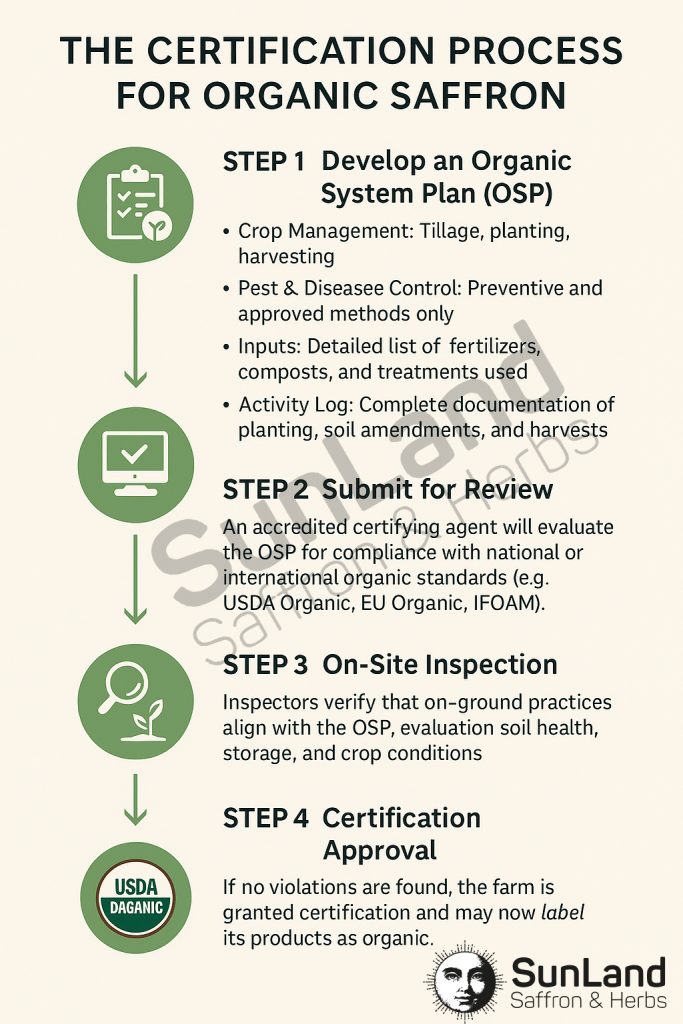
The Certification Process for Organic Saffron
To officially market saffron as organic, producers must undergo a multi-year certification journey:
Step 1: Develop an Organic System Plan (OSP)
This plan outlines all farming practices, including:
Crop Management: Tillage, planting, harvesting
Pest & Disease Control: Preventive and approved methods only
Inputs: Detailed list of fertilizers, composts, and treatments used
Activity Log: Complete documentation of planting, soil amendments, and harvests
Step 2: Submit for Review
An accredited certifying agent will evaluate the OSP for compliance with national or international organic standards (e.g., USDA Organic, EU Organic, IFOAM).
Step 3: On-Site Inspection
Inspectors verify that on-ground practices align with the OSP, evaluating soil health, storage, and crop conditions.
Step 4: Certification Approval
If no violations are found, the farm is granted certification and may now label its products as organic.
Timeline for Certification
Year
Status
1
Transition to organic practices
2
Still under evaluation (“in transition”)
3
Final inspection and potential full certification
Why Choose Iranian Organic Saffron?
Iran, the world’s largest saffron producer, has ideal growing conditions—arid climate, altitude, and traditional expertise—for cultivating high-quality organic saffron.
SunLand Saffron, a certified producer and exporter of premium-grade, non-GMO saffron, delivers farm-tested, laboratory-certified saffron products to international buyers who value authenticity, purity, and consistency. Our saffron meets both organic and ISO 3632 saffron standards for quality and coloring strength.
How to Buy Organic Saffron from Iran
If you’re looking to source certified organic Persian saffron in bulk or retail packaging:
Spain, alongside Iran, is recognized as one of the oldest cultural centers of saffron production and consumption. While Iran dominates global saffron cultivation, Spain has positioned itself as a leading …
Saffron remains one of the most coveted spices in the world, prized for its aroma, flavor, and health benefits. If you’re wondering about the saffron price in the UK, this …
Saffron Price in Canada: A Comprehensive Guide for 2025 Canada has seen a growing demand for premium-quality saffron, fueled by multicultural culinary traditions and rising awareness of its health benefits. …
Saffron, often called “Red Gold”, is one of the most valuable spices globally due to its labor-intensive harvesting process and numerous applications in culinary, medicinal, and cosmetic industries. The USA …